IG-541
A blend of nitrogen, argon and a small proportion of carbon dioxide used in engineered total-flooding systems.

Residue-free total-flooding protection for critical rooms
Engineering, supply, installation, testing, commissioning and maintenance support for IG-541, IG-55, IG-100 and IG-01 systems.
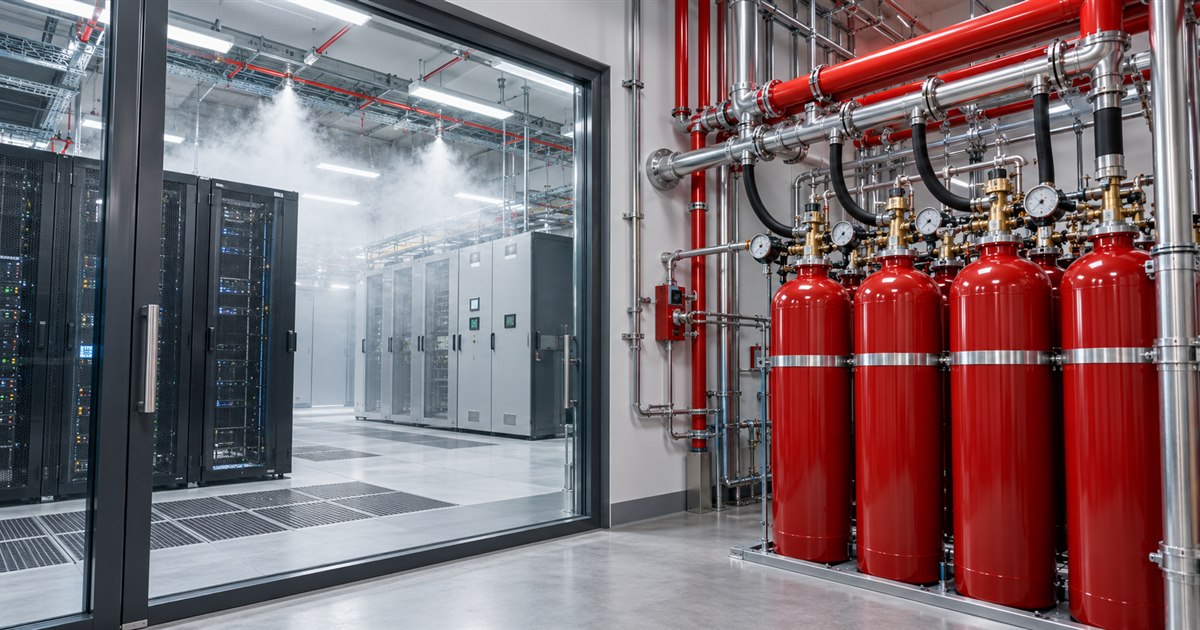
An inert gas fire suppression system is an engineered total-flooding solution that releases naturally occurring gases or gas blends into an enclosed hazard, reducing oxygen to a calculated design concentration that suppresses combustion without water or chemical residue.
The complete solution combines detection, a releasing control panel, alarms, manual release and abort devices, high-pressure cylinders, valves, a manifold, distribution pipework, discharge nozzles and equipment interfaces. Room integrity, pressure relief, personnel warning and safe egress are essential design considerations.
Reliance Fire Protection Systems supports hazard surveys, hydraulic design coordination, equipment supply, installation, testing, commissioning and lifecycle maintenance from Mumbai for projects across India.
A blend of nitrogen, argon and a small proportion of carbon dioxide used in engineered total-flooding systems.
A blend of nitrogen and argon selected according to the protected enclosure, hazard, approvals and system design.
A nitrogen-based extinguishing agent that leaves no residue and is stored as a high-pressure gas.
An argon-based agent used for suitable enclosed hazards through a designed cylinder, pipe and nozzle network.
Inert gases do not leave cleanup residue on sensitive electronics, records, machinery or protected contents.
The agents are based on gases found in the atmosphere; system selection must still follow project and regulatory requirements.
Residue-free protection for servers, network racks, raised floors, cable spaces and supporting electrical equipment.
Protection for switchgear, UPS equipment, electrical controls and enclosed power-distribution areas.
Protection for process-control, SCADA, instrumentation and industrial automation equipment.
Clean suppression for exchanges, communication rooms, signalling equipment and network infrastructure.
Waterless protection for valuable records, collections and sensitive contents where residue must be avoided.
Engineered protection for suitable enclosed technical rooms after a detailed hazard and compatibility review.
Review room volume, hazard class, occupancy, ventilation, leakage paths, equipment layout and cylinder location.
Calculate agent quantity, storage, pipe sizes, nozzle flow, discharge time and arrangement for the approved system.
Coordinate detectors, control panel, sounders, strobes, release, abort, shutdown and building-system interfaces.
Evaluate enclosure pressure during discharge and coordinate suitable relief venting when required by the design.
Verify wiring, alarms, cause-and-effect, controls, cylinders, pipework, nozzles, interfaces and project documentation.
Check cylinders, pressure, valves, actuators, hoses, pipework, nozzles, detection, controls and room changes.
Survey, design coordination, equipment supply, installation, testing and service support are available across all Indian states and union territories, subject to project scope, approvals and product availability.
It is an engineered total-flooding system that reduces oxygen to a calculated design concentration to suppress combustion without water or chemical residue.
Common designations include IG-01 argon, IG-100 nitrogen, IG-55 argon and nitrogen, and IG-541 nitrogen, argon and carbon dioxide.
They are commonly considered for data centres, server and UPS rooms, electrical and control rooms, telecom facilities, archives, museums and laboratories.
Inert gases are non-conductive and leave no agent residue, making them suitable for many critical-equipment spaces when correctly designed.
Enclosure integrity is important because the room must retain the extinguishing concentration. The project design determines leakage review and test requirements.
Discharge can create pressure changes, so the designer must assess peak pressure, room strength and venting requirements.
Yes. We support surveys, design coordination, supply, installation, testing, commissioning and maintenance from Mumbai for projects across India.
Share the room dimensions, hazard, occupancy, equipment layout, false-ceiling or raised-floor volumes, ventilation, drawings, required approvals and project location.
Call +91 96999 90424 | sales@relifire.com | Contact Reliance Fire Protection Systems