Hazard survey and enclosure review
Review the protected equipment, room volume, occupancy, connected voids, openings and ventilation before selecting an agent system.

Engineered inert-gas fire suppression for critical enclosures
Project-specific IG541 gas flooding and inert-gas fire protection for server rooms, data centers, telecom facilities, electrical rooms and other suitable enclosed hazards across India.
IG-541 is an inert-gas extinguishing blend used in engineered gaseous fire suppression systems. A total-flooding arrangement distributes the agent through designed pipework and nozzles into a protected enclosure to reduce oxygen available for combustion.
IG-541 contains 52% nitrogen, 40% argon and 8% carbon dioxide by volume. The agent leaves no extinguishant residue, but reliable protection depends on system design, enclosure performance and the approved operating sequence.
Reliance Fire Protection Systems supports surveys, engineering coordination, supply, installation, testing, commissioning and maintenance enquiries from Mumbai for project sites across India.
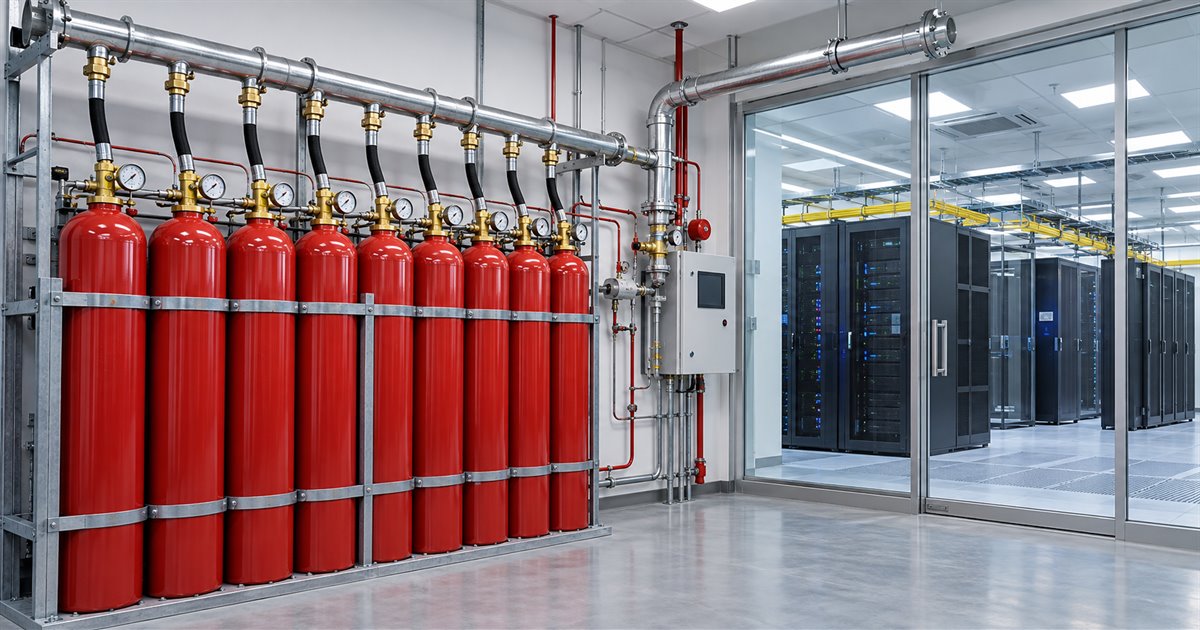
Illustrative inert-gas installation; final equipment, cylinder quantities and arrangements follow the selected manufacturer's design.
Review the protected equipment, room volume, occupancy, connected voids, openings and ventilation before selecting an agent system.
Coordinate cylinder storage, agent quantity, manifold, pipe routing, nozzle selection and manufacturer flow calculations for the proposed enclosure.
Define automatic detection, warning devices, manual controls, time delays where required, fault supervision and the documented release sequence.
Assess leakage and concentration retention, ventilation shutdown, enclosure strength and the discharge vent path as part of system engineering.
Install the selected compatible components, verify interfaces and complete the specified testing, commissioning and handover records.
Plan inspections of cylinder condition and pressure, controls, nozzles, pipework, room changes and enclosure performance under the agreed maintenance scope.
| Application | Protection to assess | Important checks |
|---|---|---|
| Data centers and server rooms | Sensitive IT equipment and enclosed electrical hazards | Room integrity, airflow, pressure relief and discharge acoustics |
| Telecom and network facilities | Communications and network equipment | Connected voids, openings, shutdown interfaces and operational access |
| Electrical and control rooms | Suitable switchgear, controls and automation hazards | Electrical isolation strategy, occupancy and agent suitability |
| Archives and other enclosed assets | Selected hazards where residue-free protection is specified | Fuel characteristics, retention, enclosure design and project requirements |
Collect the hazard, room dimensions, voids, temperature, altitude, occupancy and approval requirements.
Determine agent requirements, storage, pipework, nozzles, release controls and enclosure interfaces.
Coordinate leakage assessment, required retention, pressure relief, ventilation and operating procedures.
Complete the specified commissioning checks, interface tests, documentation and maintenance handover.
The ANSUL INERGEN manufacturer data sheet documents the IG-541 blend and product-specific design requirements. INERGEN is a brand; the exact system, current listings, compatible components and equipment availability must be confirmed for the project.
The Fire Industry Association explains the role of room integrity and agent retention and provides guidance on gas-system pressure venting. Coordinate these enclosure requirements with the selected system design.
Review applicable Indian requirements, local authority conditions, manufacturer manuals and the specified NFPA 2001, ISO 14520 or EN 15004 design basis. A reference to a standard does not establish certification of every proposed installation.
Project enquiries are coordinated from Mumbai for critical IT, electrical, industrial and institutional enclosures. Equipment supply and site services depend on the project location, selected system, approval requirements and agreed scope.
IG-541 is an inert-gas extinguishing blend used in engineered gaseous fire suppression systems. A total-flooding arrangement distributes the agent through designed pipework and nozzles into a protected enclosure to reduce oxygen available for combustion.
IG-541 is a blend of 52% nitrogen, 40% argon and 8% carbon dioxide by volume. The required agent quantity and design concentration depend on the hazard, enclosure and approved system design.
IG-541 is the extinguishing-agent designation. INERGEN is a brand name used for a particular IG-541 system offering. Confirm the actual manufacturer, system model, components and approvals rather than assuming every IG-541 installation is the same branded system.
Occupied-space suitability requires an engineered assessment of concentration, exposure, alarms, evacuation, release controls and applicable requirements. Personnel should follow pre-discharge warnings and evacuation procedures; an inert-gas system is not a guarantee that remaining in or entering the room is safe.
The enclosure must retain the required gas concentration for the specified period. Leakage paths, doors, cable penetrations, ventilation and connected voids affect performance. Room integrity assessment and sealing are coordinated with the approved design and maintenance plan.
Gas discharge can increase enclosure pressure. The design must assess allowable enclosure pressure, discharge characteristics, leakage and a suitable vent path to determine pressure-relief requirements. Vent sizing should not be selected from room volume alone.
The gas agent leaves no extinguishant residue, making it relevant to suitable sensitive-equipment hazards. System design should still consider pressure, discharge noise, airflow, fire effects and equipment sensitivity; residue-free does not mean all risks of equipment damage disappear.
The project design basis may reference NFPA 2001, ISO 14520 or EN 15004 as applicable, alongside Indian statutory and local requirements. Confirm the selected manufacturer's manuals, current component or system listings and the installation approval scope.
Cylinder quantity depends on protected volume, hazard and concentration, temperature, altitude, storage pressure, cylinder capacity, pipe routing and manufacturer flow calculations. A site survey and engineered calculation are needed for a reliable quantity and quotation.
Reliance Fire Protection Systems supports IG-541 project enquiries from Mumbai for sites across Indian states and union territories. Survey, engineering coordination, supply, installation, testing, commissioning and maintenance scope depend on the project and selected system.
Share the site location, room dimensions and drawings, hazard details, ceiling or floor voids, ventilation, occupancy, cylinder storage space, pipe route, existing detection and required approvals.
Share the site location, room dimensions and drawings, hazard details, ceiling or floor voids, ventilation, occupancy, cylinder storage space, pipe route, existing detection and required approvals.
Call +91 96999 90424 | sales@relifire.com | Contact Reliance Fire Protection Systems