
An Artificial (Automatic) Fire Suppression System is a system designed to detect and extinguish fires automatically without requiring human intervention. These systems are widely used to protect life, property, and critical equipment.
An Artificial Fire Suppression System is a sophisticated, automated safety solution designed to detect and extinguish fires quickly to prevent property damage, protect lives, and minimize business downtime. These systems use advanced technologies to suppress fires in various environments, including commercial, industrial, and residential spaces. Here’s a detailed description:
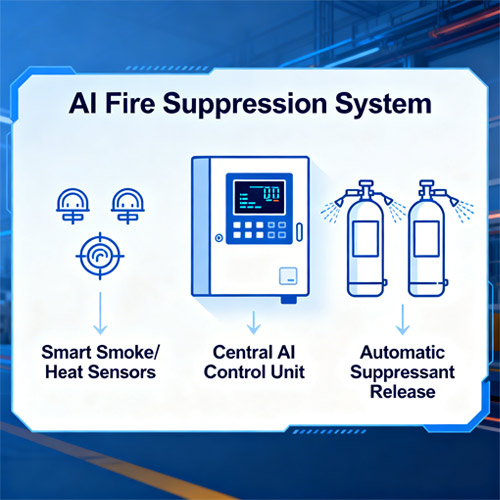
An AI fire suppression system uses artificial intelligence, sensors, and automation to detect fires early and suppress them quickly—often before they spread. Unlike traditional systems, it can analyze patterns (smoke, heat, gas levels, visual data) in real time.
AI enhances detection by:
Identifying fire risks before ignition (predictive analysis)
Reducing false alarms (e.g., distinguishing smoke vs steam)
Using computer vision from cameras to detect flames or smoke
Learning from past incidents to improve accuracy
AI systems can respond within seconds, much faster than human intervention. Some systems trigger suppression instantly once a threat is confirmed.
Depending on the environment, AI systems can activate:
Water sprinklers
Gas suppression (e.g., FM-200, CO₂)
Foam systems
Dry chemical agents
They are commonly used in:
Data centers
Warehouses
Industrial plants
Smart buildings
Airports and transport hubs
Yes, regular maintenance includes:
Sensor calibration
Software updates
System testing
Refilling suppression agents
Yes, they often integrate with:
Building Management Systems (BMS)
IoT devices
Security and alarm systems
Future systems may:
Predict fires days or hours in advance
Use drones for suppression
Integrate with smart cities for coordinated emergency response
Oxygen Reduction System
Hypoxic Fire Safety system
Hypoxic Air Protection
Hypoxic Fire Prevention System
Server Room Fire Protection System
IT Room Fire Protection System
Data Center Fire Protection
AI Fire Suppression Systems
AI Fire Protection Smoke Detector
AI Fire Alarm System
AI Based Fire Protection System Project
Oxygen Fire Protection Systems
Fire Prevention system
Ai thermal camera for critical environment
Industrial UVIR Detectors
Infrared camera fire thermal
Thermal Fire Camera
Battery Fire
Flame Detector
Spark Detector
Warehouse Oxygen Reduction System
Heritage Building Fire Protection
Museum Fire Protection System
Auto Mobile Fire Safety System
IoT-based Fire Safety Systems
Passive Fire Doors
Passive Fire Protection Tunnel System
Railway Fire Fighting Systems
Deluge System
Fire And Safty Audits
Fire Contractor
Fire Alarm
Fire Extinguisher
Jet Monitor Fire Fighting
Wet Sprinkler
Foam/Rim Seal Protection
High Velocity Water Spray System
Low Velocity Water Spray System
Vehicle Fire Safety
Fire Pressurisation System
Auto Cad Design & Estimation
Detail Engineering for complete Site
Design Consultancy as required
Aerosol Extinguishing System
Co2 flooding system
FM-200 Fire Suppression Systems
NOVEC-1230
Inert Gases
LT/HT Panel Gas Flooding System
Gas Leak Detection
Fire Evacuation Maps
Very Early Smoke Detection VESDA
Nuclear Fire Detection System
Linear Heat Sensing Detection
Pollution Wipe Box for Aviation Industries
Project Management
Mock Drills
Fire Safety Training
Advance Fire System
Lithium-Ion Battery Fire Protection
Energy Storage Fire Protection System
EV Fire Suppression Systems
Fire Consultancy Services
Honeywell Fire Alarm Systems
Oxygen Sensors for Data Centers & Server Rooms
Smoke Curtain System
UL / EN Fire Curtain System
Water Curtain System
Tunnel Fire Protection System
Simplex Fire Alarm Systems
Self-Test Smoke Detectors
IG541 Fire Gas Suppression System
Bosch Fire Alarm Systems
Fire Suppression
Fire Hydrant
Electrical Panel Gas Flooding System
Fire Fighting Mask
Vermiculite Fire Spray
fire protection contractor license
Oxygen sensors for data centers and server rooms
Warehouse Fire Protection
Fire Safety Budget Estimation
Fire Fighting Project Design Services
Bus Fire Protection – Engine & Water Mist
Data Center Fire Protection Contractors