Digital fixed-temperature cable
Two conductors contact when heat causes the temperature-rated insulation to change state, creating an alarm condition.

Continuous heat detection along extended and difficult hazards
Hazard survey, technology selection, cable routing, supply, installation, fire-alarm integration, testing and maintenance.
A linear heat detection system uses a sensing cable, tube or fibre installed along a hazard to detect abnormal heat at any point on its protected length and report an alarm or temperature event to monitoring equipment.
Unlike a point detector that monitors one location, linear sensing follows the hazard along cable trays, conveyors, tunnels, tank rims or equipment boundaries. It is especially useful where conditions are dusty, wet, corrosive, inaccessible or exposed to vibration and airflow.
Reliance Fire Protection Systems supports site surveys, product and temperature-rating selection, routing design, supply, installation, fire-alarm integration, testing, commissioning and maintenance from Mumbai for projects across India.
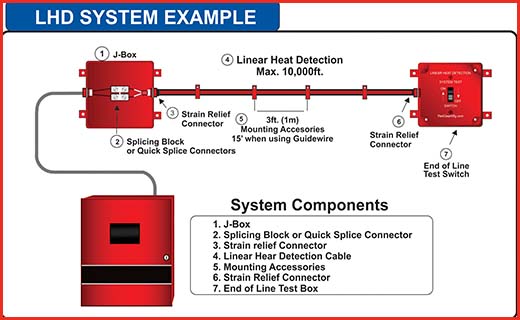
Two conductors contact when heat causes the temperature-rated insulation to change state, creating an alarm condition.
The cable's electrical characteristics vary with temperature, allowing the controller to evaluate heat over the protected length.
Optical interrogation measures temperature along long routes and can provide distance-based alarm location and thermal profiles.
A pressurised sensing tube responds to temperature-related pressure changes and connects to suitable monitoring equipment.
Interface or controller arrangements divide long hazards into identifiable zones for clearer alarm location and maintenance.
Cable jackets and construction are selected for chemicals, UV exposure, moisture, abrasion, temperature and classified locations.
Continuous coverage along power, control and communication cables where fire can spread beyond a point detector.
Sensing near bearings, drives, return rollers and conveyor routes for overheating, friction and material-fire hazards.
Long-distance heat detection and zone or location information for tunnel fire-alarm and incident-response systems.
Detection around suitable tank perimeters, floating-roof rim seals and associated hydrocarbon hazards.
Protection for racks, ceilings, freezer spaces and difficult environments where point detector access is limited.
Detection for machinery, escalators, car parks, ducts, galleries and application-specific mobile or fixed equipment.
Confirm normal and maximum temperatures, fire growth, airflow, contamination, mechanical exposure and access.
Select sensing principle, alarm temperature, cable jacket, controller and location capability for the application.
Coordinate cable position, spacing, zones, branches, joints, interface points and accessible test locations.
Use approved clips and mounting methods while respecting bend radius, tension, abrasion and environmental exposure.
Verify continuity, insulation, end-of-line supervision, alarm response, zone identification and fire-panel interfaces.
Inspect cable condition, supports, joints, controllers, fault monitoring, test facilities and changes to the protected hazard.
Survey, design coordination, equipment supply, installation, testing and service support are available across all Indian states and union territories, subject to project scope, approvals and product availability.
It uses a sensing cable, tube or fibre along a hazard to detect abnormal heat at any point on its protected length.
The method depends on the technology: digital state change, analogue electrical change, pneumatic pressure change or fibre-optic temperature measurement.
Applications include cable trays, tunnels, conveyors, warehouses, cold storage, tank rims, car parks and harsh industrial areas.
Some systems identify an alarm zone, while suitable addressable or fibre-optic systems can report a more precise distance or profile.
Some technologies reset when undamaged, while many digital fixed-temperature cables require replacement of the operated section.
Yes. Cable, supports, joints, end-of-line devices, controllers, circuits and alarm functions require planned inspection and testing.
Yes. We support surveys, design coordination, supply, installation, testing, commissioning and maintenance from Mumbai across India.
Share the hazard type, route length, ambient and alarm temperatures, environmental exposure, drawings, zone requirements, integration and project location.
Call +91 96999 90424 | sales@relifire.com | Contact Reliance Fire Protection Systems