Panels and system selection
Select the appropriate conventional or addressable panel family after reviewing building use, zone/loop needs, device counts, future expansion and project specifications.

Fire detection, alarm and lifecycle project support
Design coordination, supply, installation, testing, commissioning and maintenance enquiries for compatible Honeywell fire alarm systems in commercial, residential and industrial buildings across India.
A Honeywell fire alarm system uses a compatible control panel, automatic detectors, manual call points, notification devices and interfaces to identify fire indications, raise alarms and support the building response strategy. Features depend on the selected product family and model.
Reliance Fire Protection Systems supports project enquiries from Mumbai for new installations, system extensions, upgrade reviews and maintenance across India. The project scope depends on the building, selected equipment, existing installation and commissioning requirements.
Panel features, protocol, device limits, integration options and approvals vary between product families. We review the exact models and manufacturer documentation before defining the project solution.
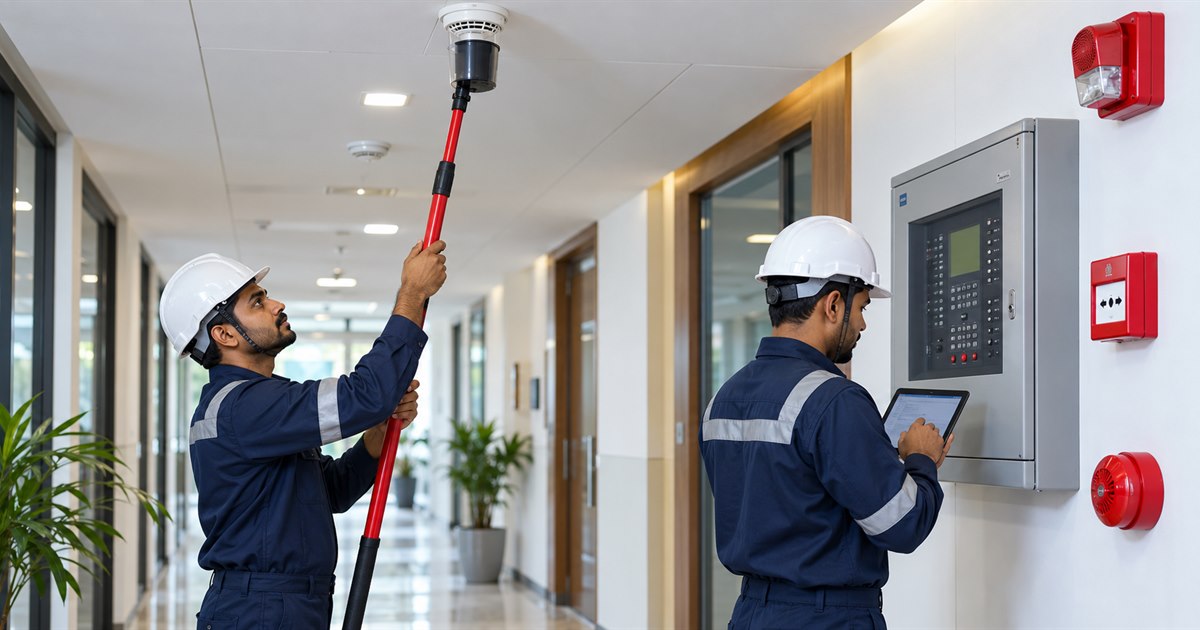
Illustrative fire alarm service scene; the image does not represent a specific Honeywell model or installation.
Select the appropriate conventional or addressable panel family after reviewing building use, zone/loop needs, device counts, future expansion and project specifications.
Coordinate compatible smoke, heat and other suitable detectors, bases, manual call points, isolators and input/output modules for the selected system.
Review sounders, visual notification, annunciators and approved building-system interfaces against the occupancy and documented alarm strategy.
Support cable routing, device installation, addressing, programming, fault checks, alarm tests, interface verification and handover documentation within the agreed scope.
Plan maintenance for panels, detectors, manual call points, alarm devices, batteries and interfaces, with service records and follow-up for identified defects.
Assess existing model details, device compatibility, loop capacity, support status and documentation before expanding or replacing a system.
| Component | Purpose | What to confirm |
|---|---|---|
| Control panel | Supervises system inputs, displays events and controls configured outputs | Product family, capacity, power supply and approved features |
| Smoke, heat and specialist detectors | Identify suitable fire signatures in protected areas | Environment, airflow, ceiling geometry and manufacturer compatibility |
| Manual call points | Allow occupants to initiate an alarm manually | Location, accessibility and compatible circuit or protocol |
| Sounders and visual notification | Provide the designed occupant warning | Coverage, ambient noise, occupancy and output capacity |
| Modules and interfaces | Monitor or control approved external signals and equipment | Compatible devices, supervision and tested cause-and-effect sequence |
Conventional systems indicate the zone where an alarm originates. Addressable systems identify individual devices, providing more detailed location and status information. The appropriate approach depends on the building layout, monitoring needs and system design.
Offices, hotels, hospitals, warehouses, factories, residential buildings, campuses and critical equipment rooms can have different detection and alarm requirements. Selection starts with the building fire strategy, layout, occupancy, environmental conditions and future expansion needs.
Review floor plans, hazards, occupancy, existing panel details, device locations and project requirements.
Confirm the panel family, compatible devices, circuit/loop design, notification and interface requirements.
Coordinate installation, programming, supervised-circuit checks, alarms and the approved interface sequence.
Provide the agreed test records, equipment information, operator handover and maintenance scope.
Honeywell describes the distinction between conventional and addressable fire alarm control panels. Exact capabilities should be checked against the selected model and its documentation. Follow applicable building and fire requirements, manufacturer instructions and the project approval process.
Honeywell is a trademark of its respective owner. Product availability, compatibility and any required manufacturer credentials must be confirmed for the project; this page does not assert authorised dealership or certification status.
Reliance Fire Protection Systems coordinates project enquiries from Mumbai for commercial, residential, industrial and institutional locations. Service availability and equipment supply are confirmed according to the project scope and site.
A Honeywell fire alarm system uses a compatible control panel, automatic detectors, manual call points, notification devices and interfaces to identify fire indications, raise alarms and support the building response strategy. Features depend on the selected product family and model.
Conventional systems indicate the zone where an alarm originates. Addressable systems identify individual devices, providing more detailed location and status information. The appropriate approach depends on the building layout, monitoring needs and system design.
No. Compatibility depends on the exact panel family, communication protocol, device model, firmware and manufacturer documentation. Devices should not be mixed solely because they share the Honeywell name.
Suitable models and approved interfaces can provide monitoring and control connections. The project must define permitted signals, the cause-and-effect sequence, supervision, compatible modules and commissioning tests. Integration does not make every product interchangeable.
Detector selection depends on the expected fire signature, ceiling height, ventilation, occupancy and environmental conditions. Smoke, heat, multi-sensor, beam or aspirating detection may suit different spaces, subject to approved design and model compatibility.
Reliance Fire Protection Systems supports Honeywell fire alarm project enquiries from Mumbai for locations across Indian states and union territories. Survey, supply, installation, testing, commissioning and maintenance scope are confirmed for the selected equipment and site.
Cost depends on the panel family, device count, loop or zone requirements, wiring, notification coverage, interfaces, programming, installation conditions and service scope. Share drawings and equipment details for a project-specific quotation.
Inspection and testing follow the approved design, manufacturer instructions, applicable requirements and site maintenance plan. Checks cover detectors, manual call points, notification devices, power supplies, batteries, faults, interfaces and records.
Provide panel and device model details, current drawings, fault history, system capacity, firmware information where available and the proposed changes. Compatibility and support status must be reviewed before adding devices, replacing equipment or planning a migration.
Share your site location, floor plans, occupancy, existing panel and device details, device quantities, interface requirements and installation or AMC scope.
Call +91 96999 90424 | sales@relifire.com | Contact Reliance Fire Protection Systems