Vehicle and fleet surveys
Review vehicle use, fuel, powertrain, compartments, hot surfaces, fluid lines, wiring, service access and any existing protection.

Vehicle-specific fire prevention and protection support
Fire-risk surveys, suitable detection and suppression selection, retrofit review, installation and maintenance support for cars, passenger fleets, commercial vehicles and mobile equipment across India.
Automobile fire safety combines vehicle maintenance, hazard control, suitable detection and warning, selected firefighting equipment, suppression where appropriate, evacuation awareness and planned inspections. The protection approach depends on the vehicle, fuel, use and approval requirements.
Potential hazards include fluid leaks near hot surfaces, damaged wiring, unsuitable electrical additions, collision damage and battery failure. Prevention begins with proper servicing and operating practices; equipment selection follows the actual vehicle risk.
Reliance Fire Protection Systems supports vehicle and fleet enquiries from Mumbai for surveys, engineering coordination, supply, installation, testing and maintenance across India.
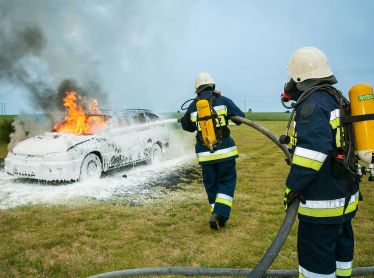
Vehicle fire-response reference image; it does not demonstrate an installed suppression system or its performance.
Review vehicle use, fuel, powertrain, compartments, hot surfaces, fluid lines, wiring, service access and any existing protection.
Identify maintenance and housekeeping issues, leakage, electrical modifications, heat exposure and other conditions needing the vehicle operator or OEM's attention.
Select suitable vehicle-rated detection and alarms for the protected hazards and operating environment, with documented response logic.
Review the suitable tested suppression arrangement and portable equipment against agent limitations, discharge coverage and vehicle conditions.
Assess mounting, pipework or hoses, wiring, controls and any required OEM interfaces without compromising exits or vehicle operation.
Coordinate installation checks, servicing, records and operator handover for the agreed equipment and maintenance scope.
| Vehicle or facility | Scope to review | Key inputs |
|---|---|---|
| Cars and light commercial vehicles | Maintenance, electrical and fuel-related risks, suitable equipment | Vehicle layout, OEM guidance and operating use |
| Buses and passenger fleets | Engine detection/suppression and separate passenger-area requirements | Vehicle category, compartment layout, exits and approval scope |
| Trucks and mobile equipment | Engine, hydraulic and equipment-specific hazards | Vibration, airflow, heat, fuel, operating conditions and service access |
| Electric and hybrid vehicles | Electrical and traction-battery risks | OEM pack design, thermal propagation, charging and specialist response guidance |
| Workshops and fleet depots | Separate premises fire-safety review | Charging, fuels, hot work, storage and the building fire strategy |
Identify the make, model, use, powertrain, compartment layout and relevant hazards.
Define detection, alarm, agent and coverage requirements within the tested application limits.
Confirm vehicle interfaces, safe controls, mounting, wiring, service access and required approvals.
Complete the specified checks, record the installation and plan ongoing inspections and servicing.
The FIA vehicle fire-suppression guide discusses industrial vehicle and mobile-equipment hazards, system choices and maintenance. Follow the exact vehicle and suppression-system instructions and the applicable approval requirements.
Electric-vehicle battery hazards need separate consideration. UL Solutions' EV battery safety overview describes electrical, mechanical and thermal risks. Battery-system testing is not a blanket approval of aftermarket suppression equipment.
Stop safely where possible, switch off the engine and evacuate everyone. Move clear of the vehicle and traffic, contact local emergency services and do not return for belongings. Do not open a hood or luggage compartment if fire is suspected inside, or attempt to fight the fire yourself.
Reference: U.S. Fire Administration vehicle fire-safety guidance. Use the local emergency service for your location.
Enquiries are coordinated from Mumbai for private operators, passenger and commercial fleets, institutions, workshops and mobile-equipment users. Equipment selection and site services depend on the vehicle and project scope.
Automobile fire safety combines vehicle maintenance, hazard control, suitable detection and warning, selected firefighting equipment, suppression where appropriate, evacuation awareness and planned inspections. The protection approach depends on the vehicle, fuel, use and approval requirements.
Possible causes include fuel or oil leaks, damaged wiring, overloaded or unsuitable electrical accessories, hot engine or exhaust surfaces, collision damage and battery faults. The actual risks should be reviewed for the vehicle and operating conditions.
No. The selected system has a defined protection scope and application limits. Engine compartments, passenger areas, cargo and traction batteries require separate assessment; protection of one area does not establish protection of the whole vehicle.
Selection depends on the vehicle hazards, fuels, electrical equipment, hot surfaces, airflow, temperature, installation conditions and the system's testing or approval scope. No single agent should be assumed suitable for every car, bus, truck or mobile machine.
No. A damaged traction battery can involve electrical hazards, thermal runaway, hazardous gases and re-ignition. A conventional engine or portable extinguisher arrangement should not be assumed to stop reactions inside a failing battery pack.
A retrofit can be considered after reviewing vehicle layout, mounting space, nozzle coverage, controls, wiring, service access and OEM or approval requirements. Installation should not obstruct exits or compromise vehicle systems.
Only after an assessment establishes suitable interfaces and a safe response for the vehicle and its operation. Stopping a moving vehicle or mobile machine can create additional risks, so shutdown logic must follow the accepted vehicle-specific design.
Stop safely where possible, switch off the engine and evacuate everyone. Move clear of the vehicle and traffic, contact local emergency services and do not return for belongings. Do not open a hood or luggage compartment if fire is suspected inside, or attempt to fight the fire yourself.
Follow the vehicle and fire-system manufacturer instructions and the fleet maintenance plan. Check leaks, wiring, housekeeping, extinguishers, detectors, storage pressure, pipework or hoses, discharge points, controls and service records within the agreed scope.
Reliance Fire Protection Systems supports vehicle and fleet fire-safety enquiries from Mumbai for locations across Indian states and union territories. Surveys, supply, installation and maintenance depend on the vehicle, selected equipment and project scope.
Share the site or fleet location, vehicle make and model, fuel or powertrain, usage, fleet quantity, protected compartments, drawings or photographs, existing equipment, service needs and any OEM or approval requirements.
Share the site or fleet location, vehicle make and model, fuel or powertrain, usage, fleet quantity, protected compartments, drawings or photographs, existing equipment, service needs and any OEM or approval requirements.
Call +91 96999 90424 | sales@relifire.com | Contact Reliance Fire Protection Systems