Risk review and scope
Assess vehicle types, battery information, charging arrangements, occupancy, adjacent exposures and the required protection objectives.

Hazard-specific protection for EV facilities and equipment
EV fire protection enquiries for charging areas, fleet depots, workshops, parking facilities and vehicle-related risks, with project-specific assessment of detection, suppression, cooling, interfaces and emergency arrangements.
An electric vehicle fire suppression system is an engineered arrangement intended to detect and control defined fire hazards in an EV-related application. Protection must be selected for the vehicle, battery, charger or facility and coordinated with cooling needs, alarms, electrical interfaces and emergency response.
Reliance Fire Protection Systems supports surveys, design coordination, equipment supply, installation, testing, commissioning and maintenance enquiries from Mumbai for EV-related projects across India.
A charger cabinet fire, vehicle interior fire and internal traction-battery event present different protection problems. The scope must identify which hazards a proposed system addresses and what remains outside its demonstrated capability.
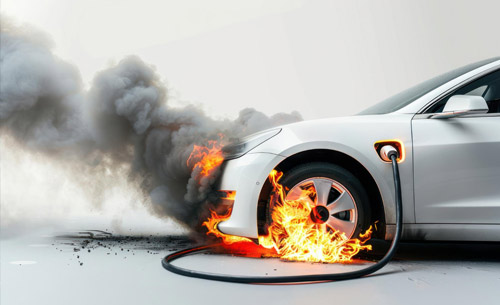
Illustrative image; it does not demonstrate the performance or certification of a suppression system.
Assess vehicle types, battery information, charging arrangements, occupancy, adjacent exposures and the required protection objectives.
Review suitable thermal, smoke or other detection with alarm thresholds, environment, coverage and response actions.
Select equipment against the defined hazard and test evidence, considering battery access, cooling and propagation limitations.
Coordinate compatible shutdown or status interfaces with electrical designers, charger suppliers and vehicle manufacturers.
Review building systems, access, separation, ventilation, water availability and emergency arrangements for the site.
Define functional tests, interface checks, records, training, inspection intervals and change-management responsibilities.
EV batteries can present heat, electrical and flammable-gas hazards. Protection planning should distinguish external flames from internal battery reactions and account for possible re-ignition and adjacent exposures.
No. Controlling visible flames does not prove that reactions inside a battery have stopped. Thermal-runaway propagation, stored energy and re-ignition require separate consideration, supported by relevant test evidence and vehicle or battery manufacturer guidance.
No. Switching off charging power or using an approved isolation interface can address defined electrical functions, but a traction battery can retain hazardous energy. Isolation does not by itself stop internal cell reactions or prove the battery safe.
| Application | Design inputs |
|---|---|
| EV charging areas and parking | Charger ratings, electrical protection, vehicle arrangement, building systems, ventilation, access and nearby exposures. |
| Electric bus and fleet depots | Vehicle types, battery details, charging cycles, fleet layout, isolation interfaces and operational requirements. |
| Workshops and dealerships | Service operations, damaged-vehicle handling, manufacturer procedures, alarm response and trained personnel. |
| Vehicle assembly and battery handling | Process hazards, battery state and condition, material flow, test evidence, monitoring and emergency coordination. |
Collect layouts, vehicle and charger details, battery information, operating needs and approval conditions.
Check equipment suitability, application limits, test reports, compatibility and manufacturer requirements.
Coordinate agreed equipment, alarm functions, interfaces and commissioning tests with the site team.
Provide agreed records and training, plan inspections and assess changes to vehicles or site operations.
IAFC EV response guidance identifies the need to consider battery cooling and possible secondary ignition. USFA’s EV blanket advisory explains why visible flame suppression can coexist with continuing battery reactions and gas hazards.
NFPA 855 concerns stationary energy storage. Confirm the applicable Indian requirements, accepted design basis, vehicle and charger instructions and relevant authority conditions for the actual EV project. Do not assume generic certifications or universal agent suitability.
Reliance Fire Protection Systems supports EV fire protection and Fire Safety Audit Services enquiries across all Indian states and union territories. Survey, design, installation and maintenance scope is coordinated from Mumbai according to the site hazards, operating needs and applicable requirements.
Delhi is a union territory; Delhi NCR also includes locations in neighbouring states. Enquiry coverage does not indicate a local office in each state or union territory.
Our EV fire protection and Fire Safety Audit Services support covers enquiries for the following industrial zones, IT parks, SEZs, logistics hubs and manufacturing clusters across India. Survey, supply, execution and service arrangements are agreed for each site.
An electric vehicle fire suppression system is an engineered arrangement intended to detect and control defined fire hazards in an EV-related application. Protection must be selected for the vehicle, battery, charger or facility and coordinated with cooling needs, alarms, electrical interfaces and emergency response.
No. Controlling visible flames does not prove that reactions inside a battery have stopped. Thermal-runaway propagation, stored energy and re-ignition require separate consideration, supported by relevant test evidence and vehicle or battery manufacturer guidance.
Enquiries can cover charging areas, fleet and bus depots, workshops, dealerships, parking facilities, vehicle assembly areas and battery handling locations. Onboard vehicle protection, building protection and stationary battery storage have different design requirements.
No. Agent choice depends on the protected hazard, access, cooling capability, enclosure, occupancy and relevant testing. A system suitable for an electrical cabinet or vehicle compartment must not automatically be treated as effective for thermal runaway inside a traction battery.
No. Switching off charging power or using an approved isolation interface can address defined electrical functions, but a traction battery can retain hazardous energy. Isolation does not by itself stop internal cell reactions or prove the battery safe.
Suitable sensors may help identify abnormal conditions where their coverage, environment, thresholds and response have been engineered. They cannot guarantee detection of every internal failure. Alarm logic and follow-up actions must be defined for the application.
No. Fire blankets must not be treated as proof that thermal runaway has stopped. USFA reports that blankets can suppress visible flames while battery reactions and flammable-gas release continue. Their role and limitations require specialist assessment.
An upgrade can be reviewed using drawings, charger and vehicle details, existing protection, electrical arrangements, access, ventilation, nearby exposures and operating procedures. Any proposed equipment or interfaces require compatibility review and commissioning.
No. NFPA 855 addresses stationary energy storage installations. It is not an approval standard for every EV, onboard system or charging installation. Applicable Indian requirements, vehicle specifications and local authority conditions must be confirmed for the project.
Follow the approved design, manufacturer instructions and site maintenance plan. Depending on the system, inspection may cover detectors, power supplies, alarms, extinguishing equipment, valves, interfaces, faults, signage and operating records, with changes to vehicles or site use reviewed.
Reliance Fire Protection Systems supports surveys, design coordination, supply, installation, testing, commissioning, audit and maintenance enquiries from Mumbai across all 28 Indian states and 8 union territories. Execution and service scope are agreed for the site, equipment and applicable credentials.
Share the site location, drawings, vehicle types, battery and charger details, parking or charging arrangement, existing protection, electrical interfaces, ventilation, utilities, approval conditions and required scope. Call +91 96999 90424 or email sales@relifire.com.
Share your site drawings, vehicle and charger information, hazards and required scope for a project-specific review.