Early detection and alarms
Coordinate smoke, aspirating, heat or gas detection with BMS signals, monitored alarms and a documented response sequence appropriate to the battery and enclosure.

Turnkey fire protection for battery energy storage
Project-specific BESS fire protection, battery-room detection, alarms, suppression, cooling and maintenance support for industrial, commercial and renewable energy installations across India.
Energy storage fire protection combines risk assessment, battery monitoring, early detection, alarms, isolation interfaces, suitable suppression, cooling, containment and emergency planning for battery rooms and battery energy storage systems.
Battery failure can release heat, smoke and flammable or toxic gases. Thermal runaway can spread to adjacent cells or modules, with the possibility of re-ignition. Lithium-ion, lead-acid and other storage technologies require different hazard assessments.
Reliance Fire Protection Systems supports surveys, engineering coordination, supply, installation, testing, commissioning and maintenance from Mumbai for battery storage projects across India. System selection follows the battery configuration, manufacturer information, project requirements and approval process.
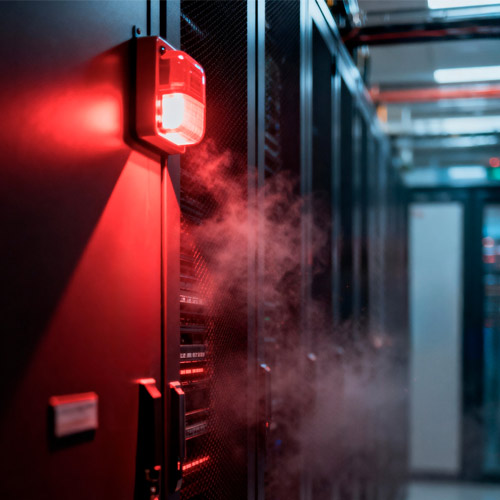
Coordinate smoke, aspirating, heat or gas detection with BMS signals, monitored alarms and a documented response sequence appropriate to the battery and enclosure.
Review suitable fire-control and cooling arrangements against battery chemistry, enclosure design, test evidence and equipment instructions, rather than treating all battery installations alike.
Coordinate approved BMS, power-conversion, electrical isolation, ventilation and alarm interfaces. Shutdown and ventilation actions must follow the engineered cause-and-effect sequence.
Assess cabinet or container arrangement, fire divisions, exposure to adjacent equipment, access routes and measures intended to limit fire spread.
Include hazardous-gas accumulation and pressure risks in the assessment. Ventilation and explosion-control requirements need specialist coordination for the actual installation.
Provide installation, commissioning, interface testing, handover records, inspections and planned maintenance within the agreed project scope.
| Application | Protection to assess | Design inputs |
|---|---|---|
| Containerised and utility-scale BESS | Cabinet/container configuration, detection, fire control, gas hazards and external exposures | Manufacturer documents, representative fire-test evidence, access and emergency arrangements |
| Indoor battery and UPS rooms | Detection, suitable suppression, electrical interfaces and room arrangements | Battery chemistry, occupancy, ventilation, escape routes and building fire strategy |
| Solar-plus-storage facilities | Battery protection coordinated with PV, inverter, transformer and site fire systems | DC/AC isolation, outdoor conditions, utility supplies and response access |
| Industrial and commercial storage | Site-specific protection for storage cabinets and associated electrical equipment | Capacity, surrounding hazards, existing plant systems and business-continuity needs |
Review location, chemistry, capacity, battery and enclosure drawings, OEM documents, available test reports and existing protection.
Consider ignition, thermal runaway, propagation, gas release, electrical exposure, occupancy and emergency access.
Select suitable detection, alarms, fire control and interfaces against the agreed design basis and authority requirements.
Install, test, commission and document the agreed systems, with service planning and operational handover.
NFPA 855 addresses stationary energy storage installation hazards. UL 9540A evaluates thermal runaway fire propagation; it is distinct from UL 9540 system certification. The relevant test results should be reviewed for the proposed battery configuration and installation.
Confirm applicable Indian electrical, building and fire requirements, local authority conditions, manufacturer instructions and any specified NFPA, UL or IEC references for the project. A service enquiry or proposal does not establish equipment certification or statutory approval.
Project enquiries are supported from Mumbai for BESS containers, battery rooms, industrial battery banks, UPS facilities and renewable energy storage sites. Installation and service availability are coordinated for the project scope and location.
Energy storage fire protection combines risk assessment, battery monitoring, early detection, alarms, isolation interfaces, suitable suppression, cooling, containment and emergency planning for battery rooms and battery energy storage systems.
No single suppression system should be assumed to stop thermal runaway inside a failing cell. Flame control, cooling and measures to limit propagation require a battery-specific design supported by manufacturer information and relevant test evidence.
Detection can combine smoke or aspirating detection, heat monitoring and gas detection with battery management system signals. Sensor selection, location and alarm thresholds depend on chemistry, enclosure layout, airflow and the documented response sequence.
Selection depends on battery chemistry, installation configuration, hazards, test data, manufacturer instructions and approval requirements. Water-based protection, local application systems or other suitable arrangements may be considered; flame knockdown alone does not establish control of thermal runaway.
UL 9540 addresses safety of energy storage systems and equipment. UL 9540A is a test method for evaluating thermal runaway fire propagation and associated fire behaviour. A UL 9540A test report is not, by itself, a UL 9540 system certification.
Projects should review applicable Indian electrical, building and fire requirements, local authority conditions and manufacturer instructions. NFPA 855, UL 9540, UL 9540A and relevant IEC standards may inform the agreed design basis; applicability and editions must be confirmed for each project.
Reliance Fire Protection Systems supports surveys, engineering coordination, supply, installation, testing, commissioning and maintenance enquiries from Mumbai for project locations across all Indian states and union territories, subject to project scope and access.
Share the site location, battery chemistry, energy capacity, cabinet or container layout, indoor or outdoor configuration, manufacturer documents, available test reports, existing protection, utilities and required approvals. The design and cost depend on these inputs.
Inspection and testing intervals follow the approved design, equipment instructions, applicable requirements and site maintenance plan. Scope may include detectors, alarms, suppression equipment, water supplies, interfaces, records and emergency response arrangements.
Share the site location, battery chemistry, energy capacity, cabinet or container layout, indoor or outdoor configuration, manufacturer documents, available test reports, existing protection, utilities and required approvals. The design and cost depend on these inputs.
Call +91 96999 90424 | sales@relifire.com | Send Your Project Enquiry