Site survey and design basis
Review the protection objective, opening or hazard geometry, adjacent exposures, occupancy, existing systems and approval requirements.

Engineered water-based fire and exposure protection
Site surveys, nozzle and hydraulic design coordination, supply, installation, deluge integration, commissioning and maintenance support for project-specific water curtain applications across India.
A water curtain system uses a designed arrangement of nozzles and pipework to discharge water across a defined area or boundary. Depending on the application, the design may support cooling, exposure protection or a specific approved opening-protection arrangement.
Reliance Fire Protection Systems supports water curtain project enquiries from Mumbai and Pune for commercial, industrial, infrastructure and other facilities across India. System selection starts with the protection objective rather than a standard nozzle layout.
Effective performance depends on the selected discharge pattern, pressure, water availability, airflow, obstructions and drainage. Detection and release controls must be coordinated with the wider fire-protection design.
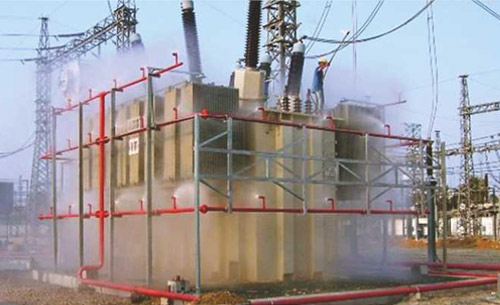
Related water-spray application image; a water curtain layout and its performance must be designed for the actual project.
Review the protection objective, opening or hazard geometry, adjacent exposures, occupancy, existing systems and approval requirements.
Coordinate the nozzle type, discharge pattern, mounting position, spacing and clearance with the intended application and manufacturer data.
Review calculated flow, pressure, pipe losses, duration, pumps and tank capacity, including simultaneous demand where required.
Select the appropriate control arrangement and coordinate detection, manual release, alarm signalling and the approved operating sequence.
Install pipework, supports, valves and nozzles, then verify controls, water delivery and the required discharge pattern through planned tests.
Check nozzle condition, valves, water supply, release controls, monitoring and drainage, with service records and follow-up for defects.
| Application | Protection objective | What to confirm |
|---|---|---|
| Exposure protection | Assess cooling of exposed surfaces and adjacent equipment | Hazard, geometry, wind, coverage and required water application |
| Building openings | Review only where the fire strategy permits a specific water-based arrangement | Accepted design basis, discharge demand, drainage and authority approval |
| Glazing protection | Consider purpose-designed sprinklers or nozzles where specified | Glazing type, framing, manufacturer listing and installation limits |
| Industrial boundaries | Review water-spray arrangements for identified process exposures | Process hazard, electrical interfaces, materials and runoff management |
In a typical open-nozzle arrangement, an approved detection and release sequence opens a control or deluge valve. Water then flows through the nozzles supplied by that valve. The exact operating sequence, manual controls and monitoring depend on the engineered design.
The approved automatic detection or manual release input starts the configured operating sequence.
The selected valve arrangement opens and supplies the relevant pipework and nozzle zone.
Nozzles discharge at the required pressure and pattern for the specified protection objective.
Responsible personnel manage the incident and restore the system under the approved procedure after checks.
Manufacturer information distinguishes water-spray applications from purpose-designed opening or glazing protection. See TYCO directional spray nozzle guidance and exposure-protection sprinkler information for examples of application-specific equipment.
Confirm relevant Indian building and fire requirements, local authority conditions, any specified water-spray or sprinkler design standards and the exact equipment instructions. A component listing does not establish approval of an entire site installation.
Project enquiries are coordinated from Mumbai and Pune for industrial plants, commercial buildings, warehouses, infrastructure and other facilities where the fire strategy identifies a suitable water-based protection arrangement. Site services depend on the project scope and location.
A water curtain system uses a designed arrangement of nozzles and pipework to discharge water across a defined area or boundary. Depending on the application, the design may support cooling, exposure protection or a specific approved opening-protection arrangement.
In a typical open-nozzle arrangement, an approved detection and release sequence opens a control or deluge valve. Water then flows through the nozzles supplied by that valve. The exact operating sequence, manual controls and monitoring depend on the engineered design.
Not as a general rule. Any proposed substitution requires a specific accepted design basis, supporting evidence and authority approval. A spray arrangement alone does not establish the fire rating or smoke-leakage performance of a wall, door or curtain assembly.
A water curtain should not be assumed to form a smoke-tight barrier or replace a smoke-control system. Smoke management, compartmentation, detection and evacuation requirements must be assessed separately within the building fire strategy.
No. These systems have different discharge patterns, operating principles and performance requirements. Water mist and specialist glazing protection rely on their own application criteria, while a fabric fire curtain is a deployable physical assembly.
The designer reviews the protected geometry, required coverage, nozzle discharge data, operating pressure, obstructions, wind or airflow, water duration and hydraulic losses. No universal spacing or flow rate is suitable for every water curtain installation.
The available pumps, tank capacity, pipework and supply pressure must support the calculated demand and any required simultaneous systems. Drainage and water collection should be checked for the expected discharge and site conditions.
Suitable detection, release controls and monitored interfaces can be coordinated with the selected valve arrangement. Confirm compatible devices, alarm and fault signals, the approved cause-and-effect sequence and commissioning tests.
Reliance Fire Protection Systems supports project enquiries from Mumbai and Pune for sites across Indian states and union territories. Survey, engineering coordination, supply, installation, commissioning and maintenance scope are confirmed for the project and location.
Share the site location, building use, protection objective, opening or hazard dimensions, drawings, water supply details, pump and tank information, drainage arrangement, detection interfaces and approval requirements.
Follow the approved design, equipment manuals and applicable requirements. Maintenance should address valve condition, nozzle obstruction or corrosion, water supply, detection and release controls, monitoring, drainage and documented functional tests.
Share the site location, building use, protection objective, opening or hazard dimensions, drawings, water supply details, pump and tank information, drainage arrangement, detection interfaces and approval requirements.
Call +91 96999 90424 | sales@relifire.com | Contact Reliance Fire Protection Systems