Ultraviolet detector
UV detectors respond to radiation in selected ultraviolet bands. They can be fast for suitable fires but may require careful control of arc, lightning or other UV-producing nuisance sources.

Optical flame detection for high-hazard industrial applications
Hazard review, detector selection, field-of-view coordination, hazardous-area integration, testing and lifecycle support.
An industrial UV/IR flame detector is an optical fire detector that evaluates ultraviolet and infrared radiation from a flame using model-specific signal processing. It initiates an alarm or output when the observed signatures meet the detector’s approved criteria.
Combining two optical bands can improve discrimination between fire and some non-fire sources, but it does not make a detector immune to every false alarm or suitable for every fuel. Selection must use verified response data for the credible fire, range and environmental conditions.
Reliance Fire Protection Systems supports surveys, design coordination, supply, installation, testing, commissioning and maintenance planning from Mumbai for high-hazard projects across India.
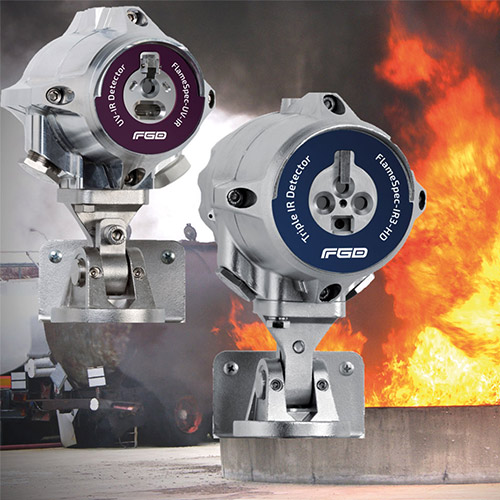
UV detectors respond to radiation in selected ultraviolet bands. They can be fast for suitable fires but may require careful control of arc, lightning or other UV-producing nuisance sources.
IR detectors evaluate radiation in a selected infrared band and model-specific flame behaviour. Response depends on fuel, range, atmosphere and interfering sources.
UV/IR devices combine evidence from ultraviolet and infrared channels to confirm a model-defined flame signature and reject some single-band disturbances.
IR3 or other multi-spectrum detectors compare multiple infrared bands to distinguish target flame signatures from background radiation for approved fuels.
Imaging or video-based analytics may identify flame-like spatial and temporal patterns and provide visual verification when approved for the application.
High-hazard projects may coordinate optical flame, heat, smoke and gas detection as independent or complementary protection layers.
Hydrocarbon, hydrogen, alcohol, solvent, sulphur, metal and other fires produce different radiation. Use approved test data for the actual fuel.
Published range normally relates to a defined test fire, orientation and sensitivity setting. Smaller, obscured or different fires may be detected differently.
The detector must see credible fire locations within its tested cone of vision. Coverage is three-dimensional and changes with distance and angle.
Equipment, structures, pipes, vehicles, storage and future modifications can block line of sight. Mountings must remain stable and accessible.
Sunlight, hot equipment, welding, flares, lightning, lamps, reflections and modulated sources must be assessed against detector immunity data.
Smoke, fog, rain, dust, oil film, salt, dirty windows and absorbing gases can attenuate radiation or obscure the detector’s view.
Process units, loading areas, pump zones, compressor areas and storage facilities may require rapid line-of-sight detection and hazardous-area equipment.
Turbines, generators, fuel systems, cable areas and auxiliaries may use flame detection with shutdown, ventilation and suppression interfaces.
Hangars, fuel handling, maintenance areas and transport infrastructure require fuel-specific detection and coordinated foam, deluge or alarm actions.
High-value or fast-developing hazards may use optical flame detection where smoke or heat detection alone cannot provide the required response.
Low-smoke or special-fuel fires require technology explicitly tested and approved for the fuel and expected environmental conditions.
Relay, analogue, digital or network outputs may initiate panel alarms, emergency shutdown, isolation, deluge, foam or remote monitoring through approved logic.
Use the manufacturer-approved flame simulator or test method at the required positions and verify detector indication and control-panel receipt.
Test alarms, voting, delays, shutdowns, isolation, suppression release, notification and remote monitoring against the approved matrix.
Inspect and clean detector windows, shields and accessories using approved materials; review contamination diagnostics where provided.
Confirm mounting direction and line of sight after equipment changes, scaffolding, storage, vehicle routes, pipework or structural modifications.
Inspect enclosure, glands, seals, earth continuity, junctions and certification-related conditions under the site’s hazardous-area regime.
Document tests, faults, bypasses, cleaning and changes, and provide temporary risk controls when any detector or interface is unavailable.
Project enquiries are supported across all Indian states and union territories, subject to hazard review, detector approvals, coverage, site classification, system interfaces, installation access and product availability.
It evaluates ultraviolet and infrared radiation from a flame using model-specific signal processing and generates an alarm when approved criteria are met.
It compares evidence from more than one optical band, improving immunity to some disturbances but not every nuisance source.
Fuel response is model-specific; select the detector using verified test data for the credible hydrocarbon, hydrogen or other fire.
Provide clear line of sight and verify model-specific range, cone of vision, obstructions, nuisance sources, weather, contamination and access.
Only when the complete installation has the certification and protection concept required for the classified area.
Use manufacturer-approved test equipment and verify optics, response, panel indication and all required cause-and-effect actions.
Yes. Reliance Fire Protection Systems supports enquiries from Mumbai across India, subject to project requirements.
Share fuels and credible fires, site drawings, equipment layout, classified-area details, environmental sources, required detection time, alarm and shutdown logic, suppression interfaces, approvals and project location.
Call +91 96999 90424 | sales@relifire.com | Contact Reliance Fire Protection Systems