Review the risk context
Identify relevant ignition sources, combustible materials, operating conditions and existing controls within the agreed scope.
Choose fire prevention measures around your facility, its hazards and operating needs. Reliance Fire Protection Systems supports enquiries for site review, technology suitability, monitoring interfaces and implementation planning from Mumbai for projects across India.
Request a consultationCall +91 96999 90424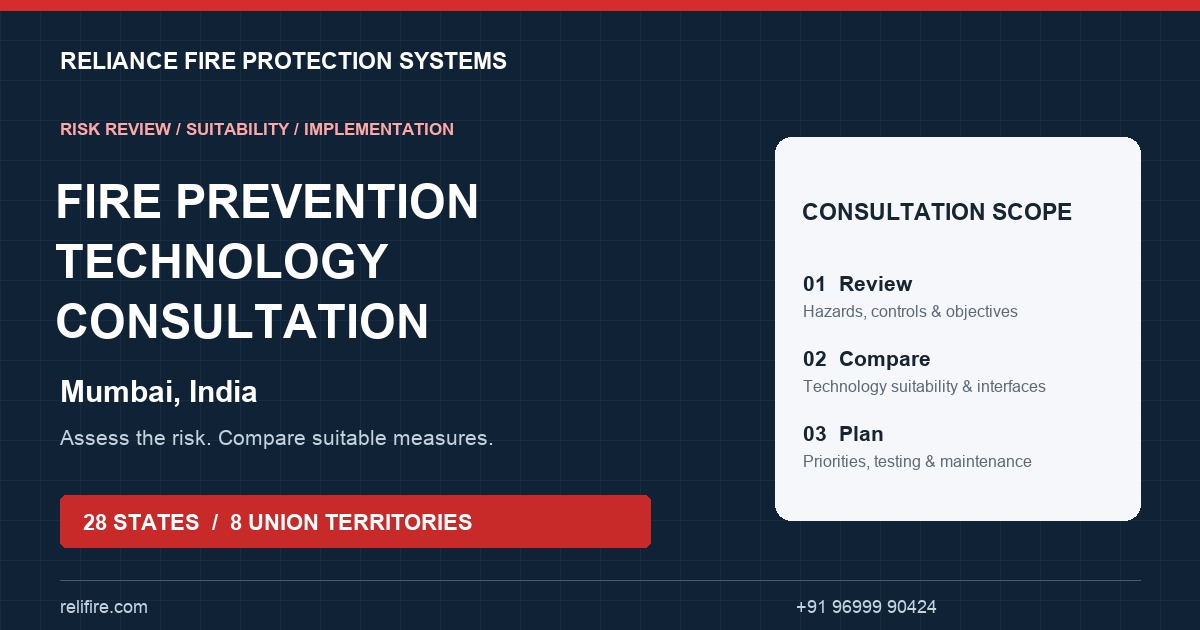
Fire prevention technology consultation reviews a facility fire-risk context and the suitability of measures intended to reduce ignition or control developing hazardous conditions. It can cover prevention controls, monitoring, system interfaces, implementation priorities and maintenance requirements.
Begin with the site activities, materials, equipment and operational constraints. The consultation should identify the problem being addressed, the limits of the review and the information needed to make an informed technology decision.
Identify relevant ignition sources, combustible materials, operating conditions and existing controls within the agreed scope.
Compare prevention and monitoring options against the hazard, environment, equipment and expected response.
Define priorities, interfaces, responsibilities, acceptance criteria and ongoing maintenance needs.
Fire prevention focuses on reducing ignition risks and controlling conditions that could lead to a fire. Monitoring can help identify selected abnormal conditions, but a signal only supports prevention when it leads to an appropriate response.
Fire detection, alarm notification, suppression and building protection serve additional purposes. Review them alongside prevention controls so that a technology upgrade fits the wider fire strategy.
Operational measures remain part of the review: housekeeping, electrical care, contractor work, management of combustible materials and control of changes to the facility.
Assess suitable sensors or thermal monitoring for selected equipment and locations. Review measurement limits, environmental effects, access and response to abnormal readings.
Discuss the monitoring needs of panels and associated equipment with the responsible electrical team. Confirm compatibility and the relationship to protective devices and maintenance.
Review suitable detection for the actual gas and environment. Consider coverage, fault reporting, alarms and any engineered response interfaces required by the project.
Assess how relevant signals reach staff or compatible building and plant systems. Define alarm ownership, escalation and fault response.
Where needed, coordinate requirements with the equipment supplier and responsible engineering team. Monitoring interfaces must not be assumed to satisfy safety-function requirements.
Review technology alongside work procedures, inspection routines, access, housekeeping and the management of changes to activities or materials.
Document the assumptions, exclusions and evidence behind an option comparison. A product feature or component rating alone does not establish the performance of the complete installation.
Discuss manufacturing, process and utility equipment, electrical rooms and other defined site hazards. Confirm where specialist assessment is required.
Review offices, healthcare, educational, hospitality and public-building needs around actual activities and occupancy.
Discuss warehouses, archives, museums, data centres and equipment rooms, taking account of materials, operations and any conservation or continuity requirements.
Enquiries can cover a new project, an existing-facility review, refurbishment or a planned technology upgrade. The proposal defines what is included.
Share your location, activities, materials, layouts, equipment details, existing systems and relevant maintenance or incident records. Explain the problem to be addressed, desired outcomes, operational constraints and required timeline.
Fees depend on site complexity, information readiness, survey needs, option depth and deliverables. Installation, detailed specialist design and certification are defined separately where required.
The UK HSE introduction to fire safety describes reviewing ignition sources, fuels and people at risk, with appropriate controls and periodic review. It is a general reference, not a statement of Indian statutory requirements.
NFPA 551 — Guide for the Evaluation of Fire Risk Assessments addresses evaluation of a fire risk assessment for a given fire safety problem. The project team should confirm applicable Indian authority requirements, adopted standards, manufacturer instructions and any necessary specialist review.
Related services: fire consultancy · fire audit · HAZOP report consultancy · Hazard Identification Reports.
From our Mumbai contact point, we welcome fire prevention consultation enquiries across India. Site visits, workshop format and availability are agreed for each project.
Fire prevention technology consultation reviews a facility fire-risk context and the suitability of measures intended to reduce ignition or control developing hazardous conditions. It can cover prevention controls, monitoring, system interfaces, implementation priorities and maintenance requirements.
Reliance Fire Protection Systems welcomes fire prevention technology consultation enquiries from Mumbai, India. Email sales@relifire.com or call +91 96999 90424 with your site location, activities, existing systems and required scope.
Prevention aims to reduce the likelihood of ignition through suitable controls and work practices. Detection provides warning when fire conditions are identified, while suppression is intended to control or extinguish a fire. A complete strategy may require all three; one should not be assumed to replace the others.
The scope can include suitable thermal or temperature monitoring, electrical condition monitoring, gas leak detection, alarm interfaces and related control measures. The review considers the actual hazards, environment, equipment compatibility and response requirements.
No. Thermal monitoring can help identify abnormal heat at selected locations where suitable. It does not detect every failure mode or replace electrical protective devices, inspections, maintenance or safe working practices.
No. Detection must be paired with an appropriate response and the wider prevention strategy. Detector suitability, coverage, alarms and any required isolation or ventilation interfaces need project-specific engineering.
Yes. An enquiry can cover existing equipment, operating conditions, documents and alarm or control interfaces. The proposal defines the survey boundary, information reviewed, exclusions and any further specialist assessment required.
Depending on the agreed scope, deliverables can include a site observation record, technology suitability review, gap and option comparison, interface requirements, implementation priorities, testing considerations and maintenance recommendations.
Share the location, facility activities, materials and equipment, layouts, existing system information, relevant incident or maintenance history, operational constraints and project goals. Include the required deliverables and timeline.
No. The consultation provides advice within its agreed scope. Certification, specialist validation and statutory approval are separate activities with the responsible bodies. Applicable project and authority requirements should be confirmed for the site.
Enquiries are welcome from all 28 Indian states and 8 union territories. Site visits, document review, engineering scope and follow-up activities are confirmed in the project proposal.
Send your site location, project goals, existing-system information and required scope to Reliance Fire Protection Systems.
Email your enquiryContact usMumbai, Maharashtra, India
# 2, Ground Floor, Albion Place, Heritage Compound, Opp. Gloria Church, Sant Savta Marg, Byculla (East), Mumbai - 400 027.
+91 96999 90424
sales@relifire.com
Site visits, scope and follow-up arrangements are confirmed in the project proposal.