PCC / Power Control Centre
Review power distribution panels, incomers, busbar sections, outgoing feeders and cable connections. Assess compartmentation and the boundaries of any proposed fire protection.
Plan fire detection, alarms and protection around your electrical panels and switchgear. Reliance Fire Protection Systems supports site surveys, system design coordination, installation, testing and maintenance enquiries for electrical equipment in industrial and commercial facilities.
Request a panel protection assessmentCall +91 96999 90424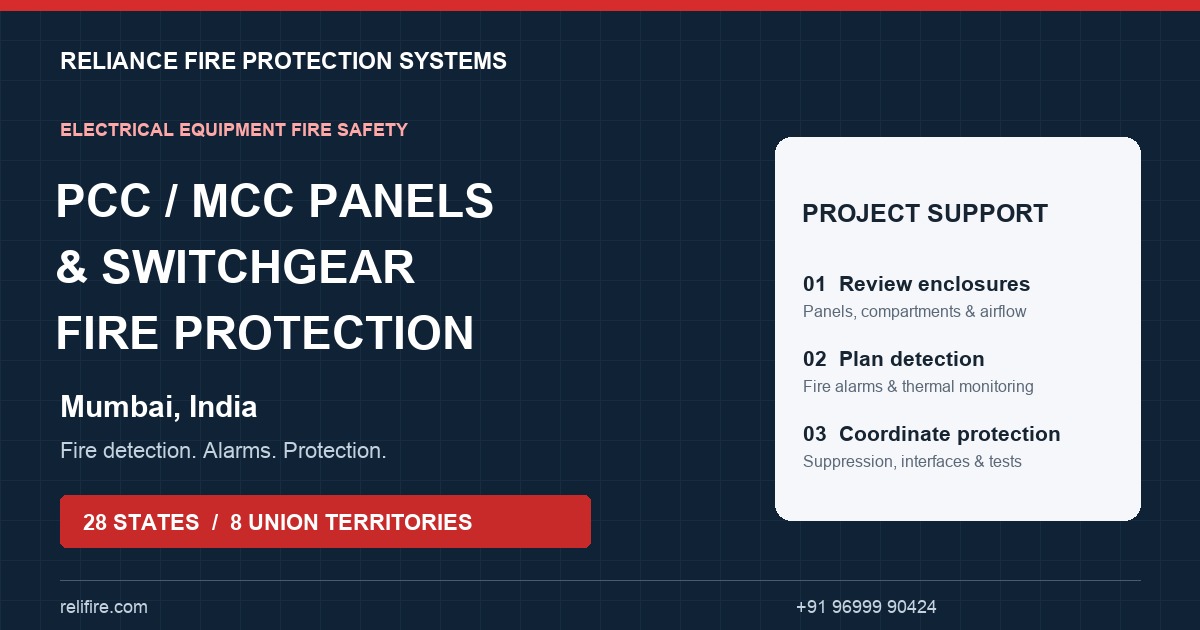
PCC, MCC panel and switchgear fire detection and protection combines suitable fire detection, alarms, thermal monitoring where appropriate and hazard-specific suppression for electrical equipment. The design considers panel construction, compartments, ventilation, electrical isolation and occupancy.
Define whether the project covers individual cabinets, connected panel sections, cable spaces or an electrical room. Each boundary has different detection, discharge and interface requirements.
Mumbai service contact: Reliance Fire Protection Systems, Byculla (East), Mumbai, Maharashtra, India. sales@relifire.com · +91 96999 90424.
Review power distribution panels, incomers, busbar sections, outgoing feeders and cable connections. Assess compartmentation and the boundaries of any proposed fire protection.
Review motor starter and feeder compartments, drives, control equipment and shared cable spaces. Consider removable units, access needs and manufacturer installation requirements.
Discuss LT or HT equipment and associated rooms. Voltage, insulation, equipment construction, ventilation and electrical clearances influence design; suitability must be confirmed for the installation.
Assess suitable smoke, aspirating smoke or specialist cabinet detection. Airflow, filters, compartment barriers and cable routes influence where a developing fire can be detected.
Review appropriate heat or linear heat detection for selected spaces and cable areas. Select ratings and installation positions for the expected environment and manufacturer limits.
Assess compatible temperature sensors or thermal monitoring at selected connections and equipment. Plan installation, data routing and alarm thresholds with the equipment specialist.
Thermal monitoring supports condition awareness. It does not replace protective relays, circuit breakers, fire detection, arc-flash risk controls or safe electrical working procedures.
Assess suitable local cabinet suppression for a defined enclosure or compartment. Consider ventilation openings, cable entries, connected sections and equipment compatibility.
Where appropriate, assess a clean-agent or other suitable room protection design. Review occupancy, room boundaries, ventilation interfaces, warning arrangements and system-specific requirements.
Coordinate alarm, authorised electrical isolation and suppression actions. A discharge does not make the equipment safe to touch or restore; electrical and fire safety clearance are required.
Extinguishing media must be suitable for the electrical hazard and the equipment. Confirm insulation compatibility, voltage limitations, occupancy precautions and the manufacturer requirements for the selected system.
For a related system scope, see electrical panel gas flooding systems.
Prepare a cause-and-effect plan before implementation. Distinguish operator information from electrical protection, shutdown and suppression-release functions.
Coordinate modifications with the switchgear manufacturer and the site electrical team. Maintain equipment clearances, compartmentation and access requirements.
Share the site location, manufacturer, panel type and voltage, dimensions, compartments, ventilation openings, cable entries and room layout. Include the single-line diagram, existing protection information and operational constraints.
Enquiries include manufacturing plants, utilities, commercial buildings, data centres, logistics facilities and infrastructure projects. Cost and schedule depend on the agreed coverage, equipment, interfaces and access.
NFPA 2001 — Standard on Clean Agent Fire Extinguishing Systems is a reference where a clean-agent system is proposed. Confirm the applicable scope and adopted edition alongside manufacturer instructions and relevant Indian authority and insurer requirements.
Electrical access, isolation and commissioning require the site electrical safety procedures and authorised personnel. For a general technical reference, see OSHA guidance on electrical work practices; this US regulation is not a statement of Indian statutory requirements.
Fire suppression does not replace electrical fault protection or arc-flash risk controls. Any certification or statutory approval is a separate process with the responsible body.
From our Mumbai contact point, we welcome electrical panel and switchgear fire safety support enquiries across India. Site visits, workshop format and availability are agreed for each project.
Our fire safety and electrical panel and switchgear fire safety support support covers enquiries from the following industrial zones, IT parks, SEZs, logistics hubs and manufacturing clusters across India. Each project is scoped to the panel construction, electrical equipment, ventilation and existing protection systems.
Mumbai and Navi Mumbai enquiries include SEEPZ SEZ, TTC Industrial Area, Taloja MIDC and Mahape IT Park. Share your facility location and panel layout and fire protection drawings to discuss the study scope.
PCC, MCC panel and switchgear fire detection and protection combines suitable fire detection, alarms, thermal monitoring where appropriate and hazard-specific suppression for electrical equipment. The design considers panel construction, compartments, ventilation, electrical isolation and occupancy.
PCC means Power Control Centre and MCC means Motor Control Centre. A PCC supports electrical power distribution and control, while an MCC groups motor control equipment. Fire protection should be designed for the actual equipment and installation.
Reliance Fire Protection Systems supports PCC, MCC panel and switchgear fire protection enquiries from Mumbai, India. Email sales@relifire.com or call +91 96999 90424 with your equipment details and drawings.
Suitable options may include smoke or aspirating smoke detection, heat detection, linear heat detection or specialist cabinet detection. Selection depends on enclosure geometry, compartments, airflow, environment and manufacturer requirements.
No. Compatible thermal monitoring can help identify abnormal heat at selected locations. It does not replace fire detection, protective relays, circuit breakers, arc-flash risk controls or electrical maintenance.
There is no single system for every panel. The review should compare suitable cabinet protection and room-level protection, considering the hazard, equipment compatibility, enclosure openings, occupancy and required approvals. Where clean agents are proposed, the design must follow the selected system requirements.
Not automatically. A cabinet system protects its defined enclosure or compartments, while room protection has a different design boundary. Assess connected sections, cable entries, ventilation and adjacent equipment before defining coverage.
No. Fire suppression is not a substitute for arc-flash assessment, electrical protective devices, safe working practices or the equipment manufacturer requirements. Fire safety and electrical protection functions need coordinated design.
Alarm, fault and system status interfaces can be assessed for compatible BMS, PLC, SCADA or fire alarm systems. Tripping, shutdown and suppression-release functions require an agreed cause-and-effect design and authorised commissioning tests.
Share the site location, panel type, voltage, manufacturer, dimensions, internal compartments, ventilation, cable entries, single-line diagram and existing fire protection details. Include room occupancy, isolation constraints, project stage and required timeline.
Enquiries are welcome from all 28 Indian states and 8 union territories. The agreed scope can include detector inspections, alarm and interface tests, suppression checks and maintenance records. Electrical access, isolation permissions and scheduling are coordinated with the site.
Share your site location, panel details and required scope to discuss the project with Reliance Fire Protection Systems.
Email your enquiryContact usMumbai, Maharashtra, India
# 2, Ground Floor, Albion Place, Heritage Compound, Opp. Gloria Church, Sant Savta Marg, Byculla (East), Mumbai - 400 027.
+91 96999 90424
sales@relifire.com
Related services: Electrical panel gas flooding · Fire alarm systems · Fire suppression systems · Fire fighting maintenance