Prevention
Reduce ignition and fire spread risks through suitable housekeeping, electrical review, contractor controls and management of activities and materials.
Coordinate fire safety around your museum, its collections and the people who use it. Reliance Fire Protection Systems supports enquiries for surveys, design coordination, alarms, suitable protection, testing and maintenance from Mumbai for projects across India.
Discuss your museum fire safetyCall +91 96999 90424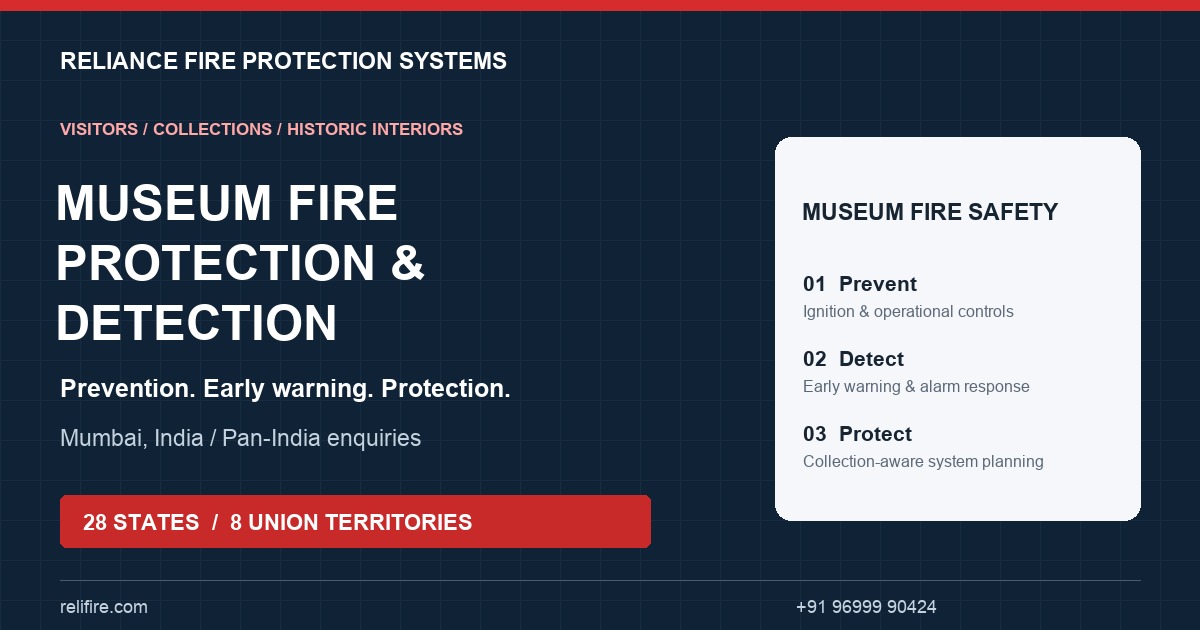
Museum fire protection, detection and prevention combines ignition risk controls, early fire detection, alarms, suitable suppression, building protection and emergency planning. The strategy should address people, collection materials, building fabric and museum operations together.
Reduce ignition and fire spread risks through suitable housekeeping, electrical review, contractor controls and management of activities and materials.
Provide suitable early warning and clear alarm communication for galleries, stores and supporting spaces, including periods when the museum is unattended.
Coordinate suitable suppression, fire separation, evacuation and response arrangements with the needs of the collections and building.
Begin with the activities and materials present in each space. Review permanent exhibits alongside temporary installations, contractor work, collection storage and supporting operations.
Document the agreed responsibilities and review changes that affect the fire strategy. See our museum fire prevention page for related service information.
Review ceiling height, air movement, exhibit layouts and display cases. Assess suitable detection without compromising coverage or conservation requirements.
Consider storage density, shelving, ventilation and access. Review suitable smoke or aspirating smoke detection where appropriate to the actual space and design.
Define alarm zones, staff notification and agreed interfaces with building systems. Plan how alarms and faults are received during opening hours and when the museum is closed.
Confirm device suitability, environmental conditions, maintenance access and the impact of installation on historic interiors before selecting equipment.
Review the fire scenario, collection materials, occupancy and building conditions together. Compare suitable systems against their performance evidence and the potential effects of fire, smoke and extinguishing media.
Assess appropriate sprinkler or water-mist options where suitable. The chosen system needs engineering for the actual hazard and installation; it must not be selected on a generic water-damage assumption.
Assess suitable gaseous or local systems for defined spaces and hazards. Review enclosure conditions, occupancy, discharge effects and collection compatibility.
Review fire separation, service penetrations, escape arrangements and installation routes. Coordinate changes to historic fabric with the responsible conservation and project teams.
Consult a conservator for sensitive materials and collection-specific effects. No extinguishing medium should be presented as universally harmless or as a substitute for a complete fire strategy.
Related service: museum fire protection systems.
Consider visitor arrangements, exhibit materials, display lighting, temporary installations and staff alarm response.
Review collection materials, storage configurations, ventilation, access and the protection boundary for each space.
Identify activities and materials in conservation, maintenance, electrical and utility areas, with suitable separation and hazard-specific protection.
Historic museums, purpose-built museums, art galleries, science museums and institutional collections may have different needs. Confirm the actual site, collections and activities in the scope.
Coordinate staff responsibilities, evacuation, responder access and collection recovery planning with the museum management team. Recovery priorities should be established with conservators and remain subordinate to life safety.
Share the museum location, layouts, building history, collection materials, display and storage arrangements, visitor and staff occupancy, existing systems and planned alterations.
Include conservation constraints, access, work windows, desired deliverables and timeline. Discuss the involvement of the museum manager, facilities team and conservator.
Fees and schedules depend on the museum, systems and agreed scope.
The US National Park Service Museum Handbook, Part I includes museum fire protection and emergency planning guidance. Its museum fire protection chapter addresses prevention, detection and suppression alongside collection care.
The National Park Service also discusses NFPA 909 for cultural resource properties and NFPA 914 for historic structures in its structural fire and cultural resources guidance. These are technical references; confirm applicable Indian authority requirements, adopted project standards and conservation permissions for the site.
From our Mumbai contact point, we welcome museum fire safety support enquiries across India. Site visits, workshop format and availability are agreed for each project.
Museum fire protection, detection and prevention combines ignition risk controls, early fire detection, alarms, suitable suppression, building protection and emergency planning. The strategy should address people, collection materials, building fabric and museum operations together.
Reliance Fire Protection Systems welcomes museum fire protection, detection and prevention enquiries from Mumbai, India. Email sales@relifire.com or call +91 96999 90424 with the museum location, drawings, collection information and required scope.
Prevention aims to reduce ignition and fire spread risks through appropriate controls and work practices. Detection identifies signs of fire and communicates an alarm. Protection includes measures such as suitable suppression and building fire separation, coordinated with evacuation and response planning.
Selection depends on ceiling geometry, airflow, dust, display cases, collection storage and maintenance access. Suitable smoke, aspirating smoke or heat detection may be assessed for different spaces. Detector coverage and alarm response should be designed for the actual museum.
There is no single system for every museum or collection. Review suitable sprinkler, water-mist, gaseous or other protection options against the hazard, occupancy, enclosure, collection materials and system performance evidence. Selection needs fire protection engineering and conservation input.
No. Suitability depends on the hazard, enclosure, occupancy, equipment and collection materials, together with the selected system requirements. Consider discharge effects, warning arrangements, pressure changes and recovery needs rather than assuming an agent is harmless to every object.
A proposal can be discussed for a historic building, but routing, fixings, visual impact, building fabric and required permissions need review with the relevant conservation and project teams. The fire strategy and conservation requirements should be coordinated before installation.
No. Detection provides warning; it does not extinguish a fire. Determine the required prevention, detection, suppression and building protection measures through the museum fire strategy and applicable project requirements.
Share the location, layouts, building and collection information, display and storage arrangements, existing-system drawings, occupancy and operational constraints. Include planned alterations, conservation requirements, desired deliverables and timeline.
Enquiries are welcome from all 28 Indian states and 8 union territories. The proposal confirms the survey, engineering, installation, testing or maintenance scope, together with site access and scheduling.
Send your site location, building and collection information, required scope and timeline to Reliance Fire Protection Systems.
Email your enquiryContact usMumbai, Maharashtra, India
# 2, Ground Floor, Albion Place, Heritage Compound, Opp. Gloria Church, Sant Savta Marg, Byculla (East), Mumbai - 400 027.
+91 96999 90424
sales@relifire.com
Related services: Museum protection · Museum prevention · Fire alarms