Application and hazard review
Assess the protected materials, ignition risks, proposed function and relationship with the building fire strategy before recommending a system.

Oxygen-reduction fire prevention for suitable enclosures
Application assessment, enclosure review, oxygen monitoring, manufacturer coordination, installation and maintenance enquiries for suitable critical rooms and enclosed storage applications.
FirePASS is an oxygen-reduction fire-prevention technology. It supplies oxygen-reduced air to a suitable enclosed area and uses monitoring and controls to maintain the engineered atmosphere for the defined fire-prevention objective.
Unlike a pre-action sprinkler arrangement, this prevention approach manages the enclosure atmosphere during normal operation. Feasibility depends on the contents, enclosure, ventilation, access pattern and the fire-prevention objective.
Reliance Fire Protection Systems coordinates FirePASS and oxygen-reduction project enquiries from Mumbai for sites across India. Scope, manufacturer involvement, equipment availability and any required credentials are confirmed for the project.
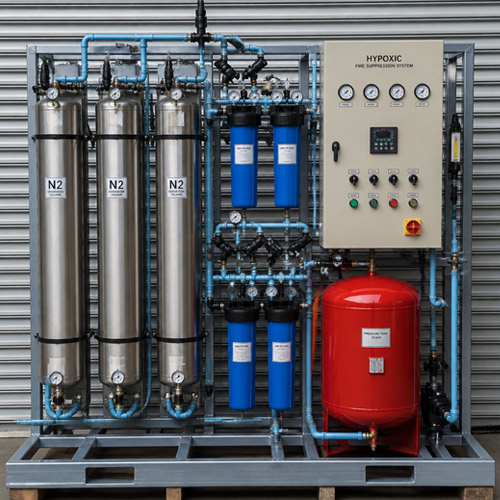
Equipment illustration; it is not evidence of a particular FirePASS model, certification or completed installation.
Assess the protected materials, ignition risks, proposed function and relationship with the building fire strategy before recommending a system.
Review the room boundary, penetrations, doors, ventilation, connected voids and operating pattern to assess technical feasibility.
Coordinate manufacturer inputs, generator and distribution requirements, capacity, utilities and maintenance access for the actual enclosure.
Define suitable sensors, alarms, fault monitoring, interfaces and documented responses to abnormal conditions or power loss.
Coordinate the selected equipment and verify monitoring, controls, interfaces and required environmental performance against the approved design.
Plan sensor calibration, servicing and checks after changes to room contents, doors, ventilation, occupancy or enclosure condition.
| Application | Scope to consider | Important inputs |
|---|---|---|
| Data centers and server rooms | Potential enclosed critical-equipment applications | Airflow, leakage, occupancy, maintenance access and the wider fire strategy |
| Archives, libraries and museums | Selected storage or conservation rooms | Materials, enclosure, access patterns and contents-specific requirements |
| Warehouses and high-value stores | Defined enclosed areas where feasible | Frequent openings, volume, materials and utility demand |
| Industrial and process sites | Specific suitable protected rooms, not an entire open industrial estate | Hazard, ventilation, process conditions, occupancy and authority acceptance |
Identify the enclosure, contents, fire strategy, occupancy and required approval process.
Review leakage, openings, ventilation, utilities and manufacturer application limits.
Define the proposed plant, distribution, sensors, alarms, interfaces and operating procedures.
Complete the specified commissioning checks, records, servicing and room-change reviews.
The manufacturer's FirePASS operating-concept information describes oxygen-reduction fire prevention. Product details and system configurations should be checked against the current manufacturer documents rather than inferred from the words “Fire PASS.”
ISO 20338 addresses fixed oxygen-reduction systems for fire prevention, including design, installation and maintenance. Confirm the accepted design basis, current applicable references, local requirements and occupational conditions for the installation.
FirePASS is a brand name of its respective owner. This page does not establish authorised dealership, certification, universal occupancy suitability or exemption from other required fire-protection measures.
Reliance Fire Protection Systems supports FirePASS and oxygen-reduction fire-prevention enquiries across all Indian states and union territories. Feasibility and site-service scope are assessed for the actual protected enclosure and application.
Delhi is the union territory listed here; the wider NCR also covers locations in neighbouring states. Coverage refers to project enquiries, not a local office in each location.
Our Fire Safety Audit Services and fire-prevention project support cover enquiries for the following industrial zones, IT parks, SEZs, logistics hubs and manufacturing clusters across India. FirePASS suitability applies only to assessed enclosures; this list does not imply that oxygen reduction is suitable for every process or an entire open site.
FirePASS is an oxygen-reduction fire-prevention technology. It supplies oxygen-reduced air to a suitable enclosed area and uses monitoring and controls to maintain the engineered atmosphere for the defined fire-prevention objective.
No. In this context, FirePASS refers to the manufacturer's oxygen-reduction technology. It should not be expanded as Permit to Access Safety System or Pre-Action Safety and Suppression System. Pre-action sprinklers and access permits are separate systems or procedures.
An engineered system produces and distributes oxygen-reduced air to the protected enclosure. Sensors and controls monitor conditions and regulate operation. Required capacity and performance depend on the enclosure, leakage, ventilation, fuels and operating conditions.
No universal occupancy or safe-entry claim should be made. The project must assess oxygen concentration, exposure, occupancy, access, alarms, procedures and applicable occupational requirements. A fire-prevention target is not automatically an acceptable exposure condition for every person.
Potential applications include suitable enclosed data rooms, archives, stores and other protected spaces after a hazard and enclosure assessment. Large openings, frequent door use, ventilation demand, materials and operating needs can affect feasibility.
Not automatically. The building fire strategy and approval process determine what detection, alarms, suppression and other safeguards remain necessary. An oxygen-reduction installation should not be presented as a general exemption from required fire protection.
A prevention installation maintains a designed oxygen-reduced atmosphere during normal operation. A conventional total-flooding suppression system generally releases agent in response to a fire condition. Specific manufacturer product configurations and their intended function must be reviewed separately.
Room volume, leakage, door openings, ventilation, target conditions, equipment configuration, duty and utility requirements affect capacity and operating demand. A site survey and manufacturer design inputs are needed before selecting equipment or estimating costs.
Suitable equipment can provide configured monitoring and control interfaces. Confirm the exact product, supported signals, fault supervision, power-loss response and approved cause-and-effect sequence before specifying integration.
No. Reduced external oxygen should not be assumed to stop internal reactions in a failing battery cell. Lithium-ion battery hazards need a separate assessment, representative evidence and application-specific protection measures.
Reliance Fire Protection Systems coordinates FirePASS and oxygen-reduction enquiries from Mumbai for sites across Indian states and union territories. Feasibility, manufacturer coordination, equipment availability, credentials and site-service scope are confirmed for each project.
Share the project location, room drawings and volume, contents and hazards, occupancy and access patterns, ventilation and leakage information, existing fire systems, utility availability and approval requirements.
Share the project location, room drawings and volume, contents and hazards, occupancy and access patterns, ventilation and leakage information, existing fire systems, utility availability and approval requirements.
Call +91 96999 90424 | sales@relifire.com | Contact Reliance Fire Protection Systems