Survey and design coordination
Review the fire strategy, protected rooms, equipment, cable and service voids, occupancy, ventilation, existing systems and authority requirements.

Fire-protection project delivery for critical IT environments
Survey, engineering coordination, supply, installation, testing, commissioning and maintenance support for enterprise data centers, server rooms, colocation facilities and related critical infrastructure across India.
A data center fire protection contractor coordinates the agreed survey, engineering, supply, installation, testing, commissioning and maintenance of fire-safety systems. Scope can include early detection, alarms, suppression, interfaces and enclosure-related works for critical IT spaces.
Reliance Fire Protection Systems supports project enquiries from Mumbai for new facilities, room expansions, upgrades and maintenance. The agreed scope is coordinated with the facility owner, consultants, equipment manufacturers and relevant authorities.
Work in critical IT facilities requires careful planning around access, operating constraints, equipment sensitivity, live services and change control. System selection must follow the hazard and approved fire strategy rather than a one-system-fits-all approach.
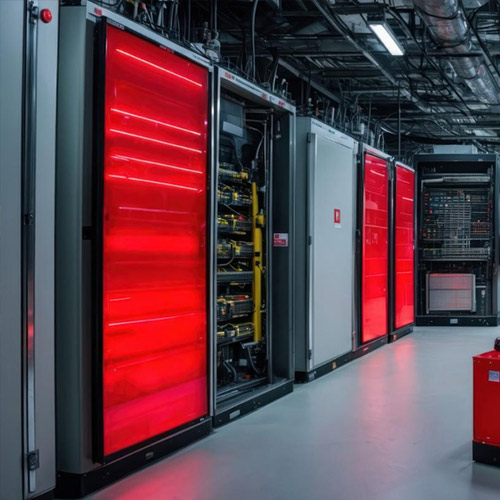
Illustrative data center image; final equipment, design and project scope are confirmed for each installation.
Review the fire strategy, protected rooms, equipment, cable and service voids, occupancy, ventilation, existing systems and authority requirements.
Coordinate suitable aspirating or point detection, alarm panels, manual controls and notification for the environmental conditions and room layout.
Select and install the agreed gas or other suitable suppression arrangement with compatible components, engineered calculations and documented release controls.
Review room sealing, integrity assessment, pressure relief and interfaces with HVAC, BMS and other facility systems against the approved sequence.
Verify installed equipment, alarm and fault functions, relevant interfaces, release controls and required system tests before operational handover.
Plan inspection, servicing and change reviews for detectors, panels, suppression equipment, enclosure alterations and operational records.
| Protected area | Scope to assess | Important inputs |
|---|---|---|
| Data halls and server rooms | Detection, alarms and suitable room protection | Airflow, containment, rack layout and enclosure boundaries |
| Raised floors and service voids | Coverage where the fire strategy requires it | Cables, leakage paths, access and integration with room protection |
| UPS and battery spaces | Separate assessment for electrical and battery hazards | Battery chemistry, ventilation, propagation and system limitations |
| Electrical and control facilities | Suitable detection and hazard-specific protection | Equipment, occupancy, isolation strategy and adjacent exposures |
Review drawings, hazards, business needs, interfaces, existing systems and site operating constraints.
Agree the design basis, equipment, calculations, room works and responsibilities before installation.
Follow the agreed work plan and complete relevant mechanical, electrical, alarm, interface and enclosure tests.
Provide agreed records, operating information, staff handover and maintenance planning for continued service.
The agreed handover package may include approved and as-built drawings, equipment schedules, calculations, interface records, test and commissioning results, relevant room integrity records, operating instructions, training records and the maintenance scope.
NFPA 75 addresses fire protection of IT equipment and equipment areas. Its applicability should be reviewed alongside Indian building and fire requirements, local authority conditions, the building fire strategy and equipment instructions.
For total-flooding gas systems, the FIA's room integrity guidance explains why enclosure leakage and agent retention matter. The FIA guidance on system attestation also describes documentation at design, installation, commissioning and handover stages.
Confirm project-specific licences, manufacturer credentials, product listings and approval evidence before appointment. A standards reference is not a company certification or an assurance of uninterrupted operation.
Enquiries are coordinated from Mumbai for enterprise, colocation, telecom, institutional and disaster-recovery facilities. Supply, site execution, commissioning and AMC availability depend on the location and agreed scope.
A data center fire protection contractor coordinates the agreed survey, engineering, supply, installation, testing, commissioning and maintenance of fire-safety systems. Scope can include early detection, alarms, suppression, interfaces and enclosure-related works for critical IT spaces.
The design may combine aspirating or point smoke detection, addressable alarms, suitable gaseous suppression, water-based building protection, portable extinguishers and passive fire protection. Selection depends on the building fire strategy, protected hazards, occupancy and approval requirements.
No single suppression arrangement is suitable for every facility. Enclosure integrity, hazard, ventilation, occupancy, available space, pressure effects, equipment sensitivity and manufacturer limitations must be reviewed before choosing a system.
A total-flooding gas system depends on retaining the required agent concentration for a specified period. Room integrity assessment helps identify enclosure leakage and evaluate retention; penetrations, doors and ventilation changes can affect the result.
Suitable approved interfaces can provide monitoring and control signals. Define the exact cause-and-effect sequence, permitted shutdowns, fault monitoring and commissioning tests with the facility team. Building monitoring does not replace required fire alarm and release functions.
Existing facilities need a coordinated method, access plan, change controls, isolation arrangements and agreed work windows. Whether a particular task requires shutdown depends on the scope and risk assessment; uninterrupted operation should not be guaranteed in advance.
The agreed handover package may include approved and as-built drawings, equipment schedules, calculations, interface records, test and commissioning results, relevant room integrity records, operating instructions, training records and the maintenance scope.
Review relevant project experience, technical staff, proposed design basis, applicable licences, equipment documentation, required manufacturer credentials, test procedures and service capability. Ask for current evidence rather than relying on general certification claims.
Reliance Fire Protection Systems supports enquiries from Mumbai for data centers, server rooms, colocation facilities and related sites across Indian states and union territories. Site services, supply, installation, commissioning and AMC scope are confirmed for each project.
Share the site location, facility type, drawings, room dimensions and voids, equipment and battery hazards, ventilation details, existing systems, operating constraints, required interfaces, approval requirements and installation or maintenance scope.
Share the site location, facility type, drawings, room dimensions and voids, equipment and battery hazards, ventilation details, existing systems, operating constraints, required interfaces, approval requirements and installation or maintenance scope.
Call +91 96999 90424 | sales@relifire.com | Contact Reliance Fire Protection Systems